Navigating UserGems
This guide walks through every section of the UserGems platform, in the order you'll find them in the sidebar. Use it to orient yourself, then click through each tab once; the layout will feel familiar fast.
The sidebar
The navigation sidebar has eight items:
- Home: your reporting and program overview
- Audiences: the companies and prospects UserGems has surfaced for you
- Campaigns: the workflows that act on your audiences
- Signals: the signal library and your signal configuration
- Writing Agent: Gem-E, your AI messaging workspace
- ICP and Scoring: your ideal customer profile and scoring models
- Reporting: pipeline, revenue, and buying stage analytics
- Settings: connections, tracking lists, personas, and platform configuration
Home
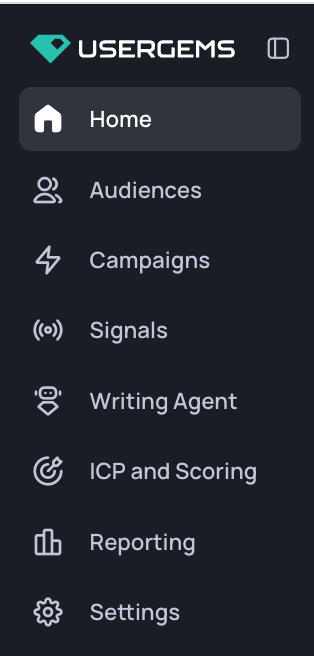
Home is your program at a glance. At the top you'll find two panels side by side:
- Campaigns shows your playbooks (Turn past champions into new pipeline, Revive closed lost, Win Back Churned Companies, Select and prioritize ABX accounts, Protect and accelerate open opps, Retain and grow customers, and more), each with its workflow count, records sent, and activation status. Anything not yet activated shows an Activate button right there.
- Signals mirrors your signal activation status, so you can see at a glance that Past Champions, New Hires, Promotions, Multi-thread, Contact and Account Intent, and the rest are on.
Below those:
- Credit usage summary shows your license period and how much of it has elapsed, plus a credit breakdown across contacts tracked, contacts created, companies tracked, and Research Agent records. Click View detail for the full picture.
- Time Savings quantifies what the automation is doing for you: records processed, estimated hours saved, and estimated dollars saved for each automation type, like new contacts auto-created in CRM, personalized AI-generated emails, and prospects auto-enrolled in sequences.
- Pipeline & Revenue is your headline scoreboard: Influenced Opps, Influenced Pipeline, Pipeline to Spend Ratio, Cost per Opp, Influenced Closed Revenue, ROI, Forecasted Closed Revenue, and Forecasted ROI, with filters for date range, influence type, deal stage, owner, campaigns, signals, and more. Toggle the chart between Opportunities, Pipeline, and Closed Revenue.
Audiences
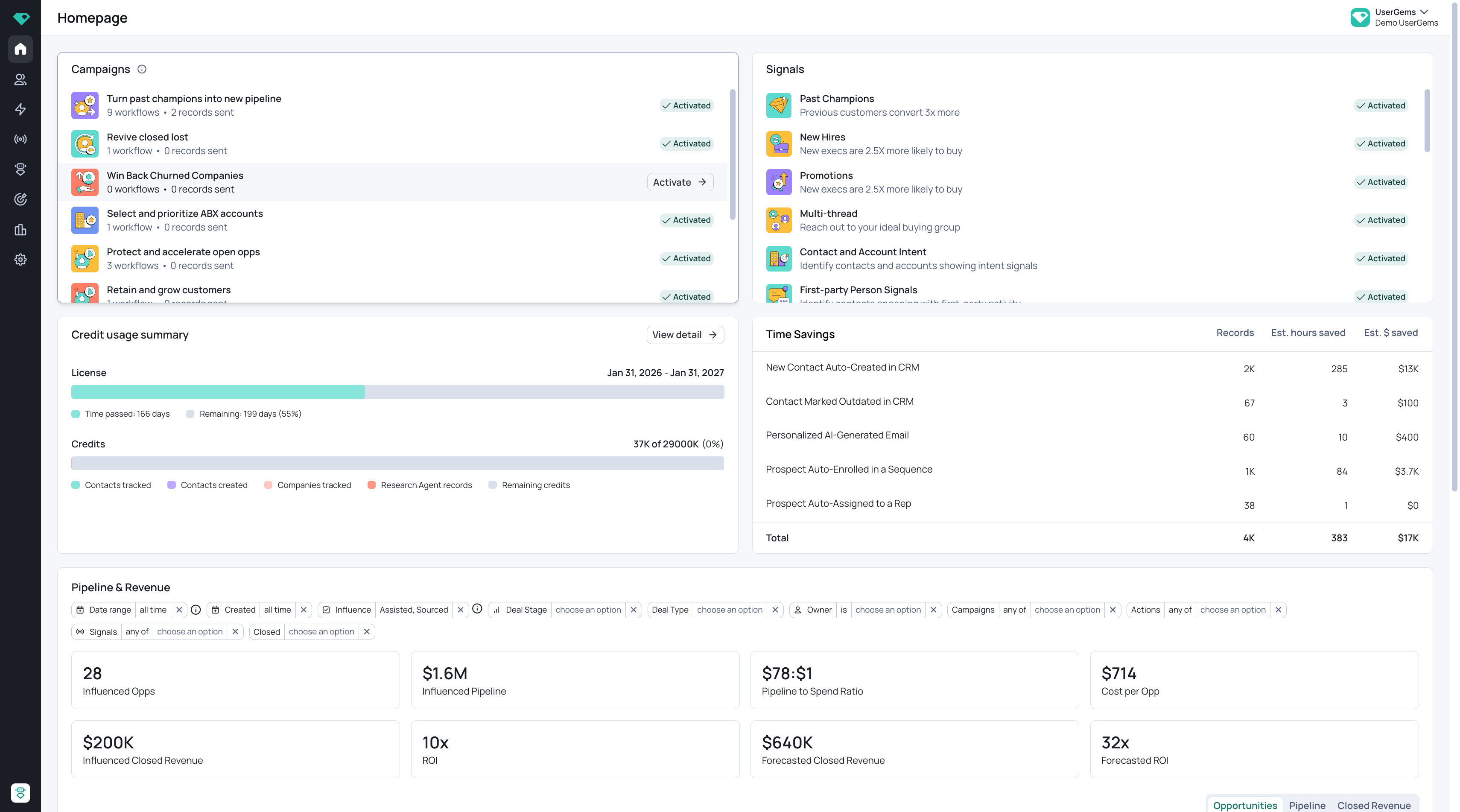
Audiences is where you explore every company and prospect UserGems is tracking or has surfaced. The table shows each company with its type (Customer, Open Opp, Target, ICP), employee count and industry, its letter-grade Score, its Buying Stage (from Unengaged through Customer), and the Signals currently firing on it, like Past Champions, Event Attendees, Intent topics, LinkedIn Posts, or Hiring.
Switch between View by Company and View by Prospect, expand any company row to see its individual prospects, or use Add prospects to bring in more. The footer shows your full universe at a glance: total companies and total prospects.
Audience filters
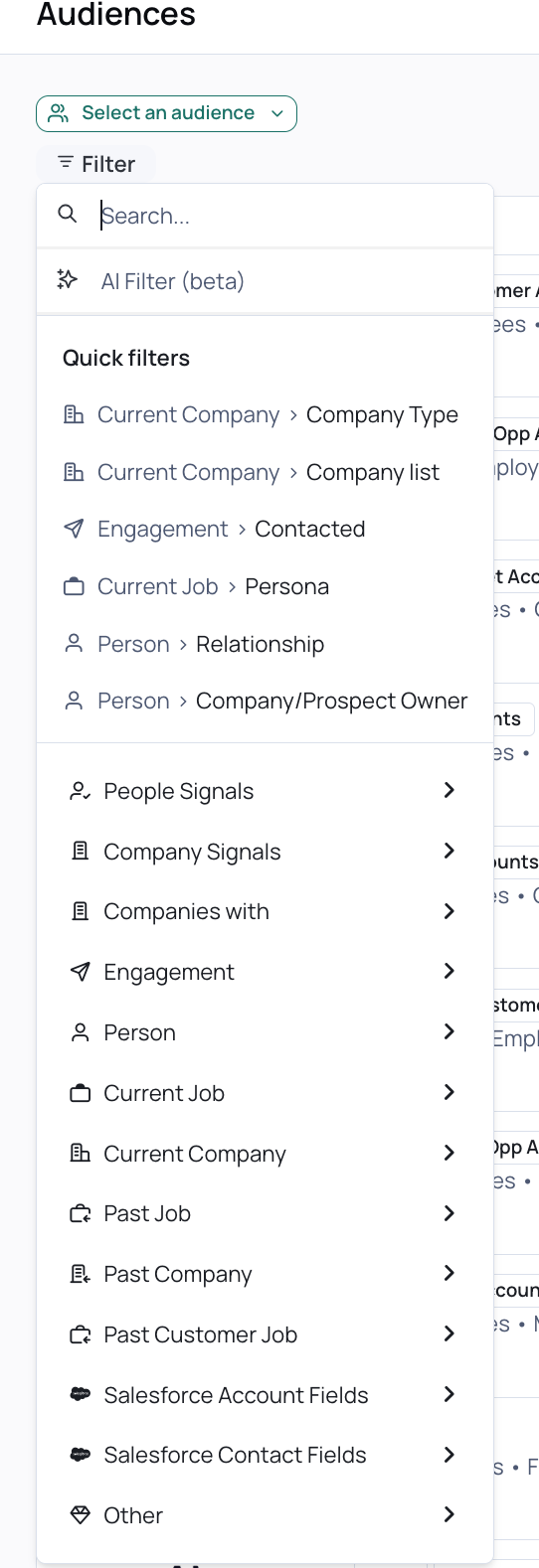
Click Filter to slice the audience. Quick filters cover the most common cuts: Company Type, Company list, Contacted, Persona, Relationship, and Company/Prospect Owner. There's also an AI Filter (beta) where you describe the audience in plain language.
The full filter groups: People Signals, Company Signals, Companies with, Engagement, Person, Current Job, Current Company, Past Job, Past Company, Past Customer Job, Salesforce Account Fields, Salesforce Contact Fields, and Other. Fields imported from your CRM live in the Salesforce field groups and Other.
Campaigns
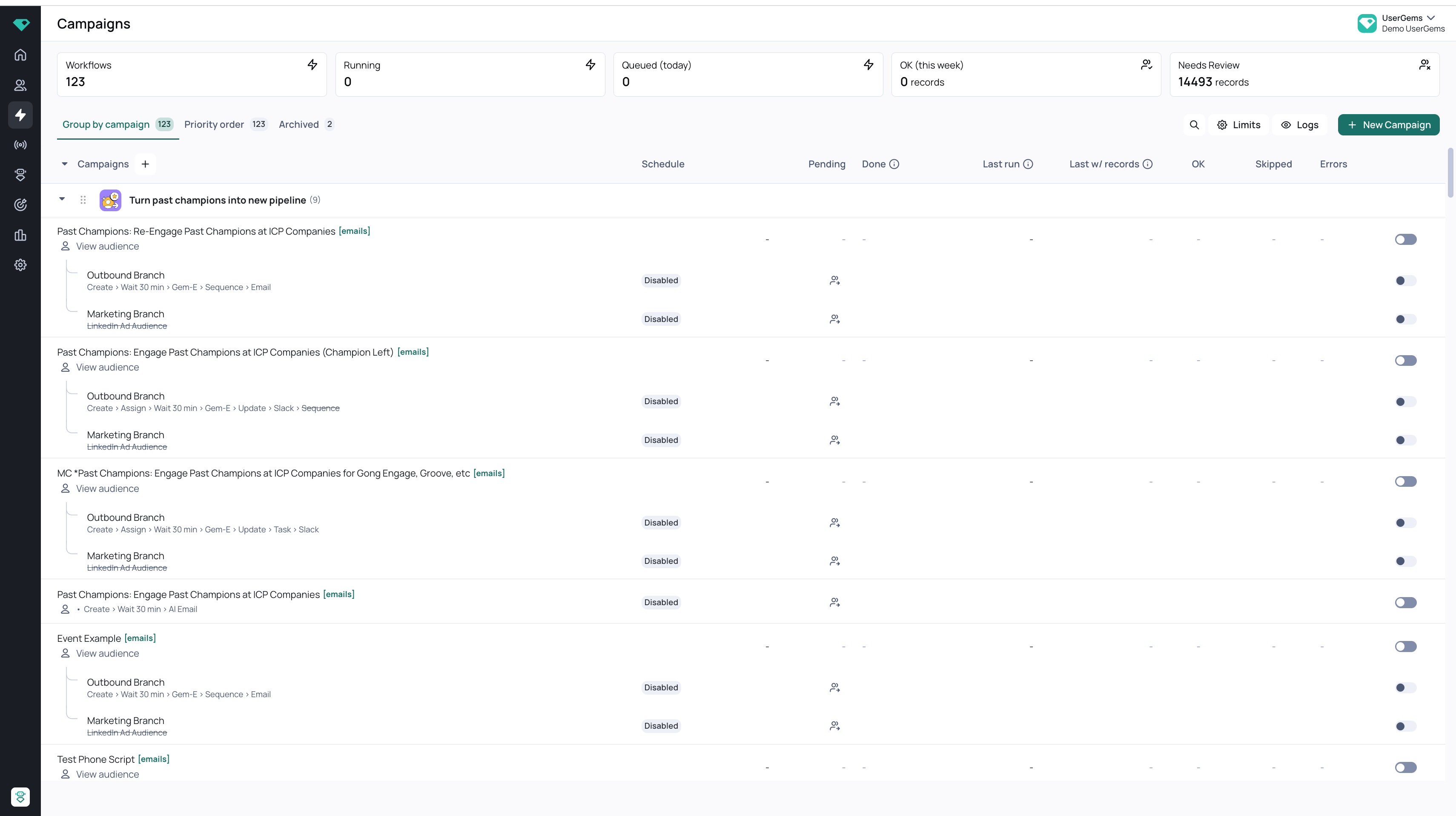
The Campaigns homepage is mission control for your workflows. The tiles across the top show total Workflows, currently Running, Queued today, records OK this week, and records that Need Review. Campaigns group their workflows beneath them; each workflow row shows its action chain (for example Create, then Wait 30 min, then Gem-E, then Sequence, then Email), its Outbound and Marketing branches, its schedule, and its run stats: Pending, Done, Last run, OK, Skipped, and Errors. Toggles on the right activate or deactivate each workflow and branch.
Use the tabs to switch between Group by campaign, Priority order, and Archived. New Campaign lives top right, alongside Limits and Logs.
Campaign logs
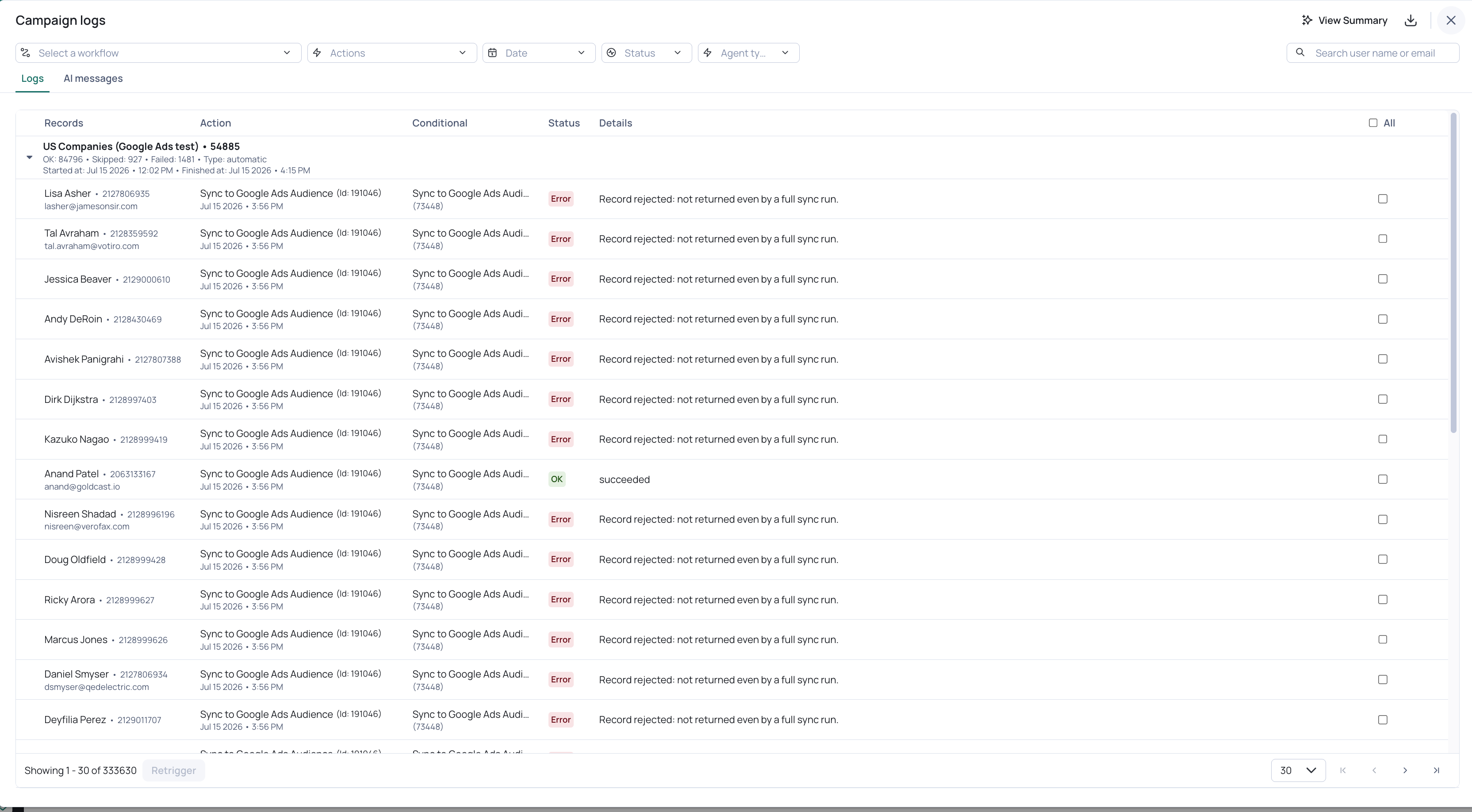
Logs is your audit trail. Filter by workflow, action, date, status, and agent type, or search for a specific user by name or email. Each run shows its totals (OK, Skipped, Failed), whether it was automatic or manual, and start and finish times. Expand a run to see every record it touched: the action taken, the conditional branch it matched, the status, and the details when something failed, like "Record not returned from LinkedIn sync" or "Record rejected: not returned even by a full sync run." Failed records can be selected and retriggered right from the log.
The campaign workflow editor
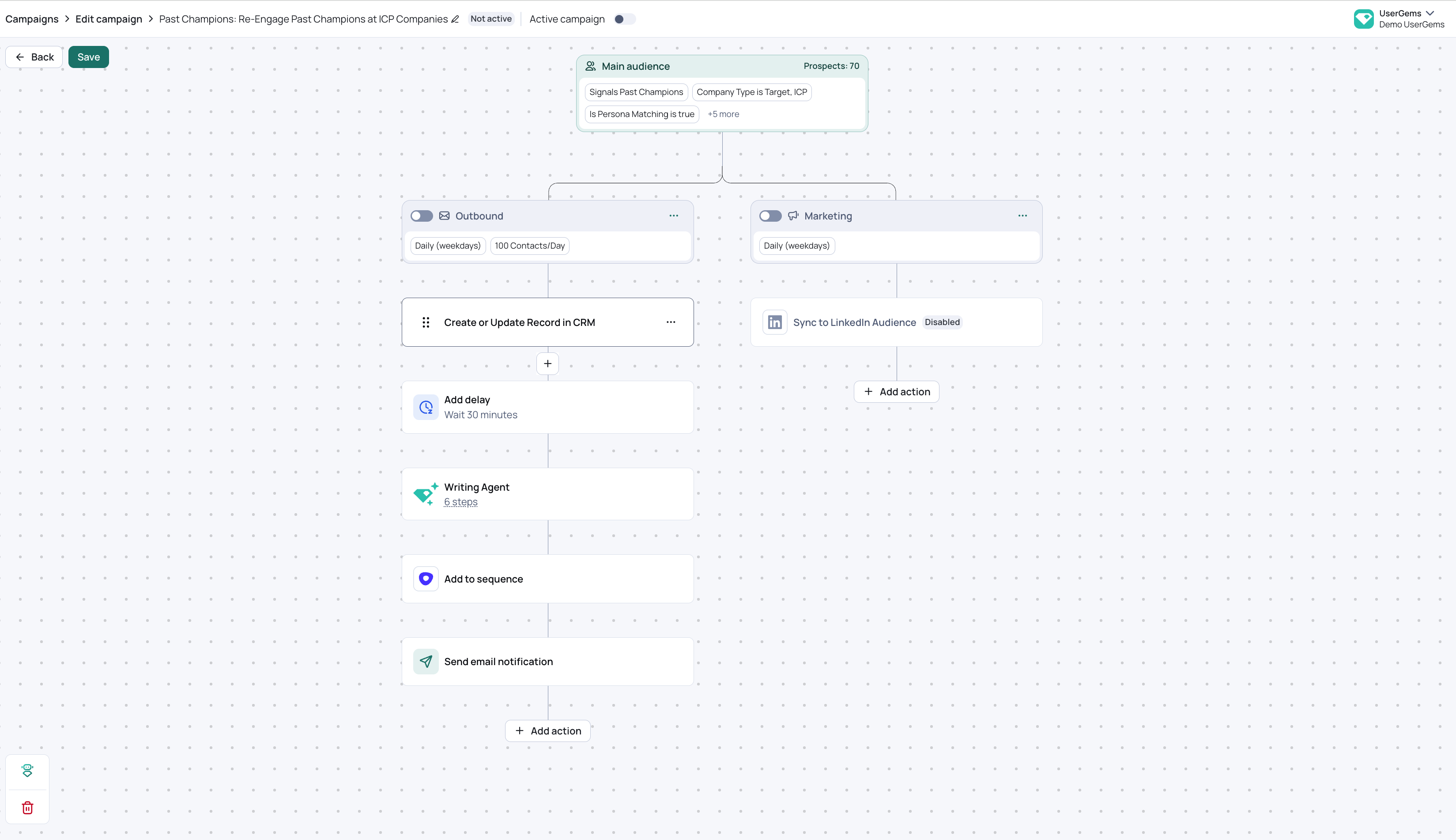
Open a campaign to see its workflow on a visual canvas. At the top sits the Main audience node with its filter chips and live prospect count. From there the workflow splits into branches:
- Outbound runs the rep-facing actions on its own schedule (for example daily on weekdays, capped at 100 contacts per day): Create or Update Record in CRM, a delay, the Writing Agent generating messaging, Add to sequence, and notifications.
- Marketing runs marketing actions like Sync to LinkedIn Audience on its own schedule.
Each branch has its own on/off toggle and schedule. Click Add action anywhere in a branch to extend it.
Campaign actions
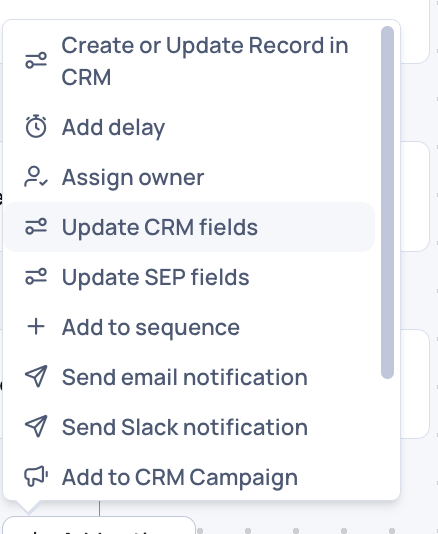
The action menu includes: Create or Update Record in CRM, Add delay, Assign owner, Update CRM fields, Update SEP fields, Add to sequence, Send email notification, Send Slack notification, and Add to CRM Campaign.
Click into any action to configure it. Add to sequence, for example, lets you select the sequence (with a downloadable sequence template), choose who the prospect is sequenced by (like the CRM record owner), decide what happens if the prospect is already active in another sequence (remove and re-add, keep both, skip, or stop the workflow), optionally create the prospect in your SEP if it doesn't exist, and control custom field mapping. Add condition lets the same action behave differently for different subsets of the audience. The editor even warns you when a sequence's templated steps don't match what Gem-E generates.
Signals
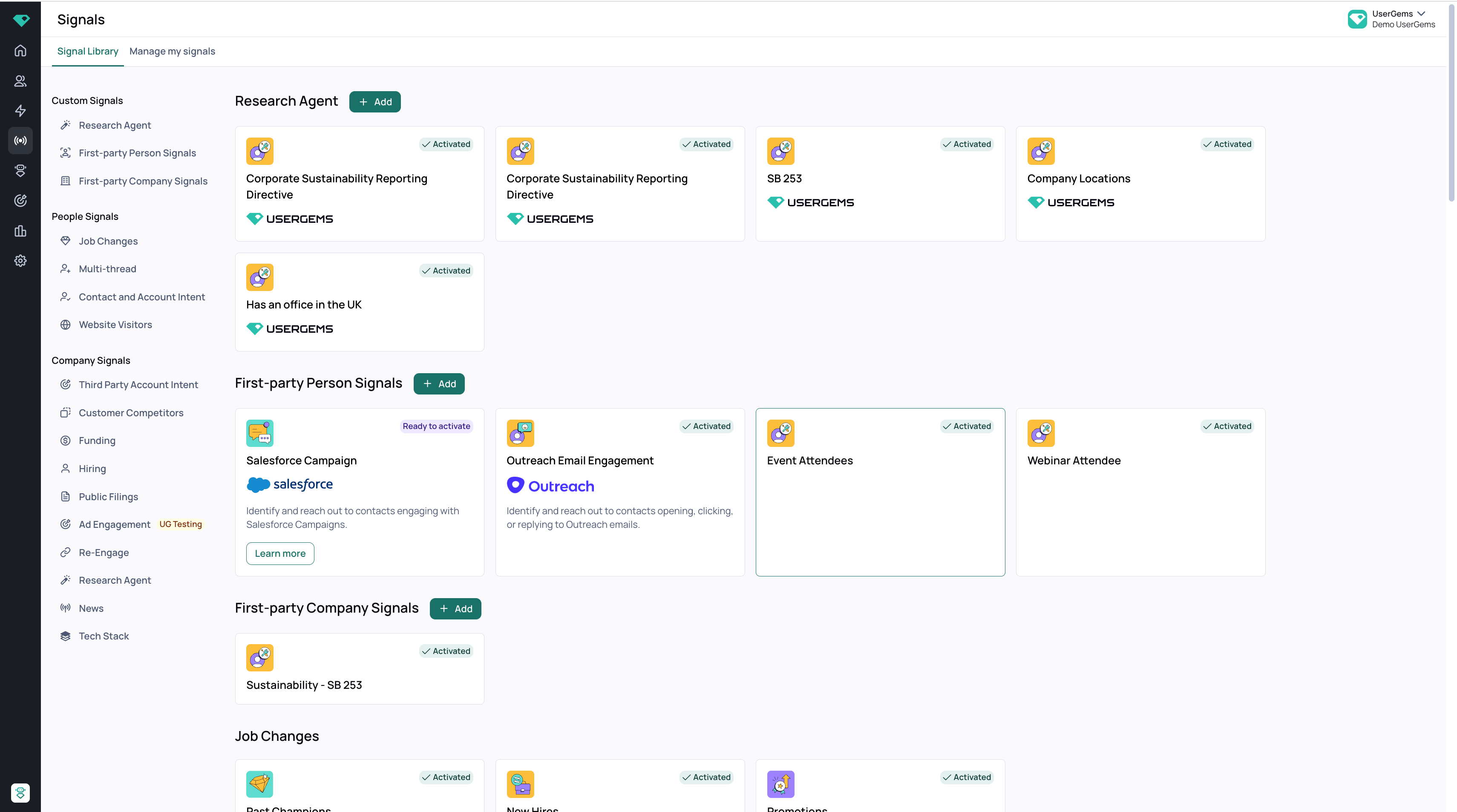
The Signals page has two tabs: Signal Library, where you browse and activate signals, and Manage my signals, where you maintain the ones you've configured.
The library is organized into three groups:
- Custom Signals: Research Agent signals and your first-party person and company signals, like Salesforce Campaign engagement, Outreach Email Engagement, Event Attendees, and Webinar Attendees.
- People Signals: Job Changes, Multi-thread, Contact and Account Intent, and Website Visitors.
- Company Signals: Third Party Account Intent (6sense, Demandbase), Customer Competitors, Funding, Hiring, Public Filings, Ad Engagement, Re-Engage, News, Tech Stack, and more.
Each card shows its activation status, and Add buttons let you create new custom signals.
Customizing a signal
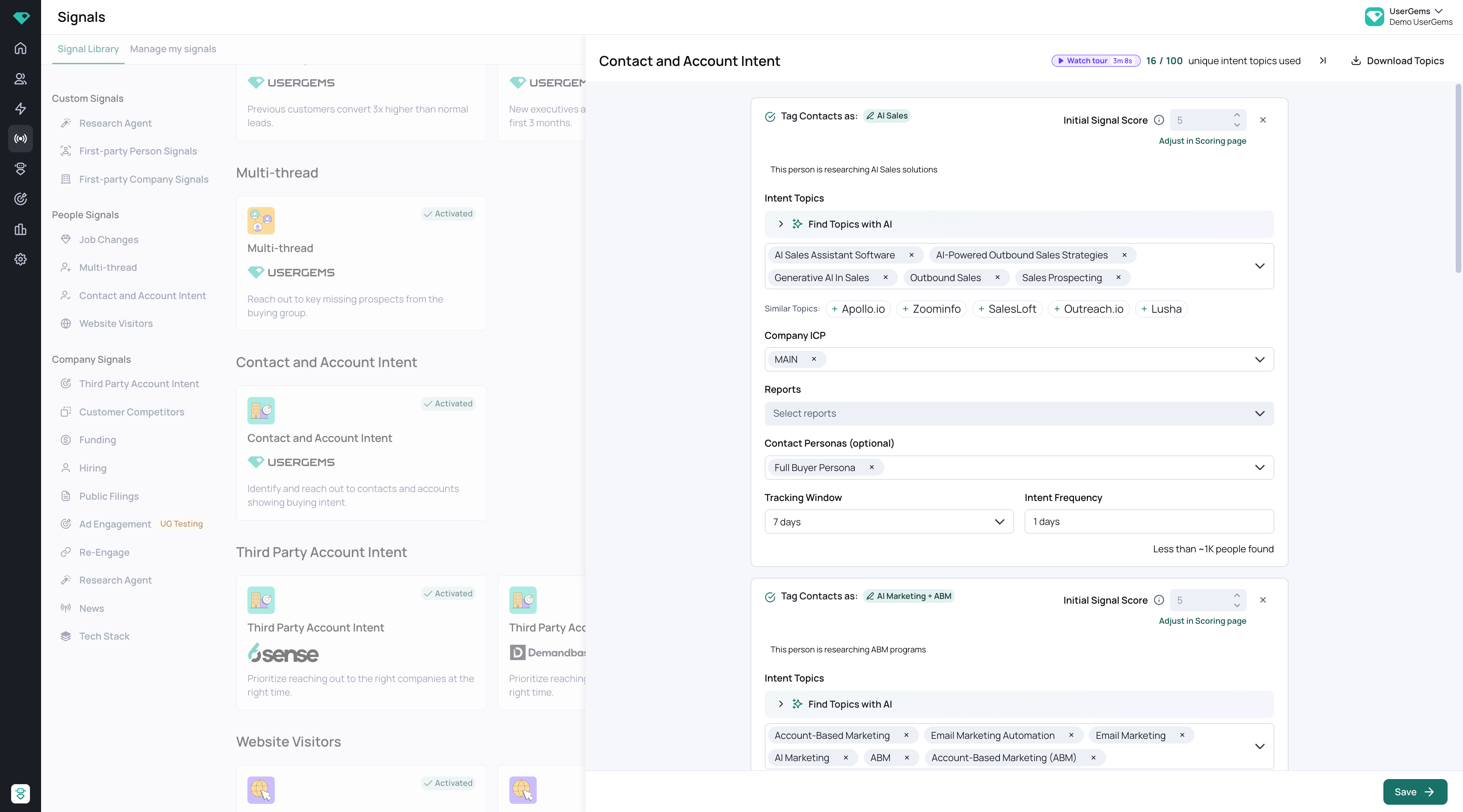
Click into a signal to configure it. Contact and Account Intent is a good example of how deep this goes: you can create multiple configurations, each tagging contacts with a label (like AI Sales or AI Marketing + ABM), carrying its own initial signal score (adjustable on the Scoring page), its own intent topics (with Find Topics with AI to suggest them, plus similar topic recommendations), a Company ICP scope, optional reports and contact personas, a tracking window, and an intent frequency. The page even estimates how many people each configuration will find before you save.
Writing Agent
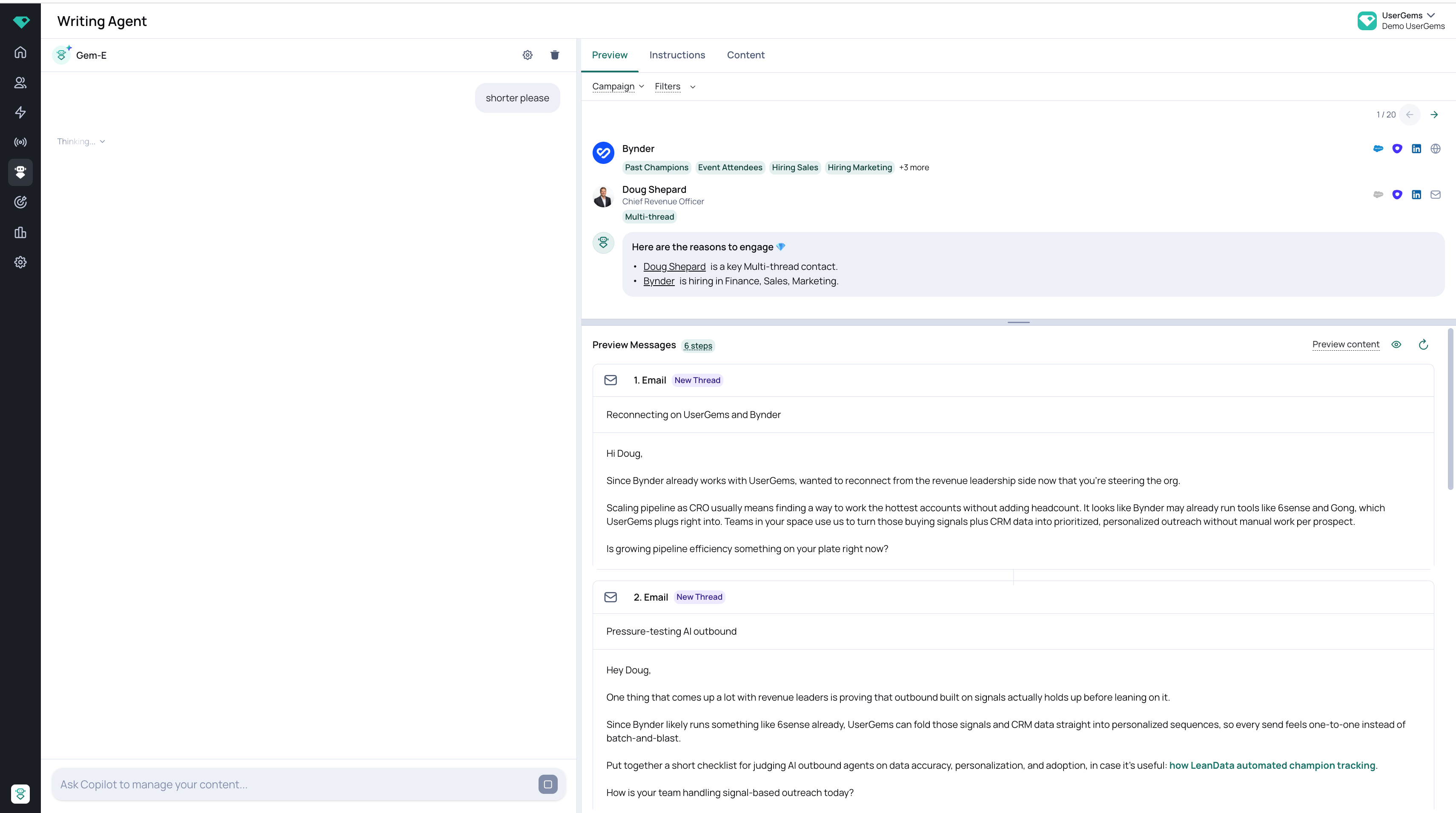
The Writing Agent is Gem-E's home. The left side is a chat where you give Gem-E broad guidance about your messaging, and it shows its thought process as it works. The right side has three tabs:
- Preview shows real generated messaging for real prospects: the company and contact with their signals, the reasons to engage that Gem-E identified, and the full multi-step message preview, email by email, with new-thread and reply-thread steps marked. Page through prospects and regenerate as you refine.
- Instructions holds the standing instructions shaping every email.
- Content is Gem-E's library: Value Propositions, Signal Playbooks, Conditional Instructions, Case Studies, Links, Product Updates, Email Templates, and more. Each item shows its filters and has its own enable toggle, and each section shows how many items are active, like 3 of 5 Value Propositions. Search, prioritize, and add content from here.
ICP and Scoring
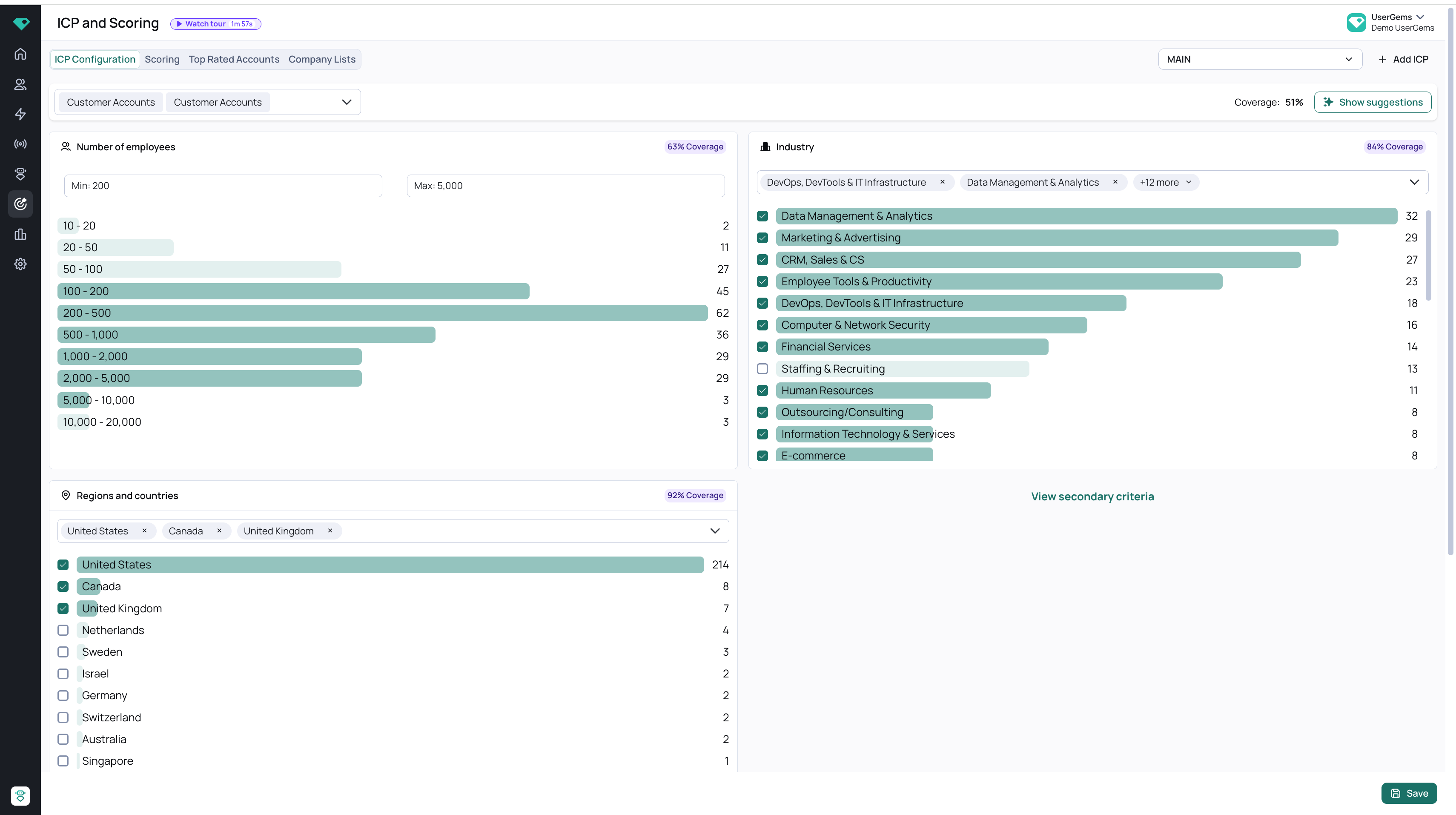
This page has four tabs: ICP Configuration, Scoring, Top Rated Accounts, and Company Lists. A selector at the top switches between your ICPs, and Add ICP creates another.
- ICP Configuration defines who you sell to: number of employees (with a distribution chart of your source accounts), industries, and regions and countries, each showing its coverage of your selected source list, like Customer Accounts. Show suggestions drafts criteria from your real data, and View secondary criteria goes deeper.
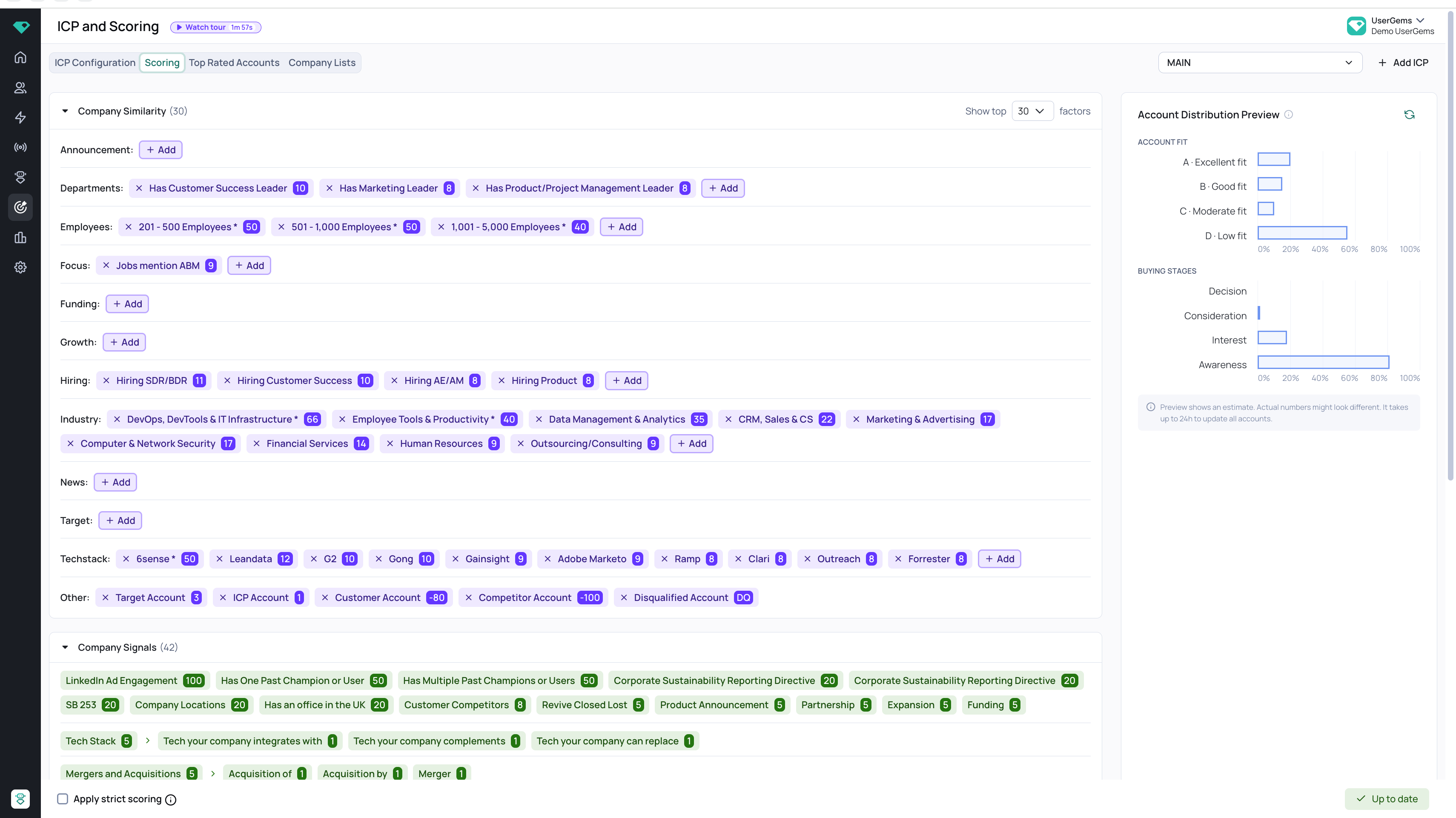
- Scoring exposes the model itself. Company Similarity lists the lookalike factors with their point values: departments, employee ranges, focus areas, hiring patterns, industries, tech stack, and account types, including negative points like Customer Account and Competitor Account that remove companies from targeting. Company Signals shows the score each signal contributes. The Account Distribution Preview on the right shows how your accounts spread across A through D fit grades and buying stages as you tune. Changes recalculate, and the page tells you when scores are up to date.
Reporting
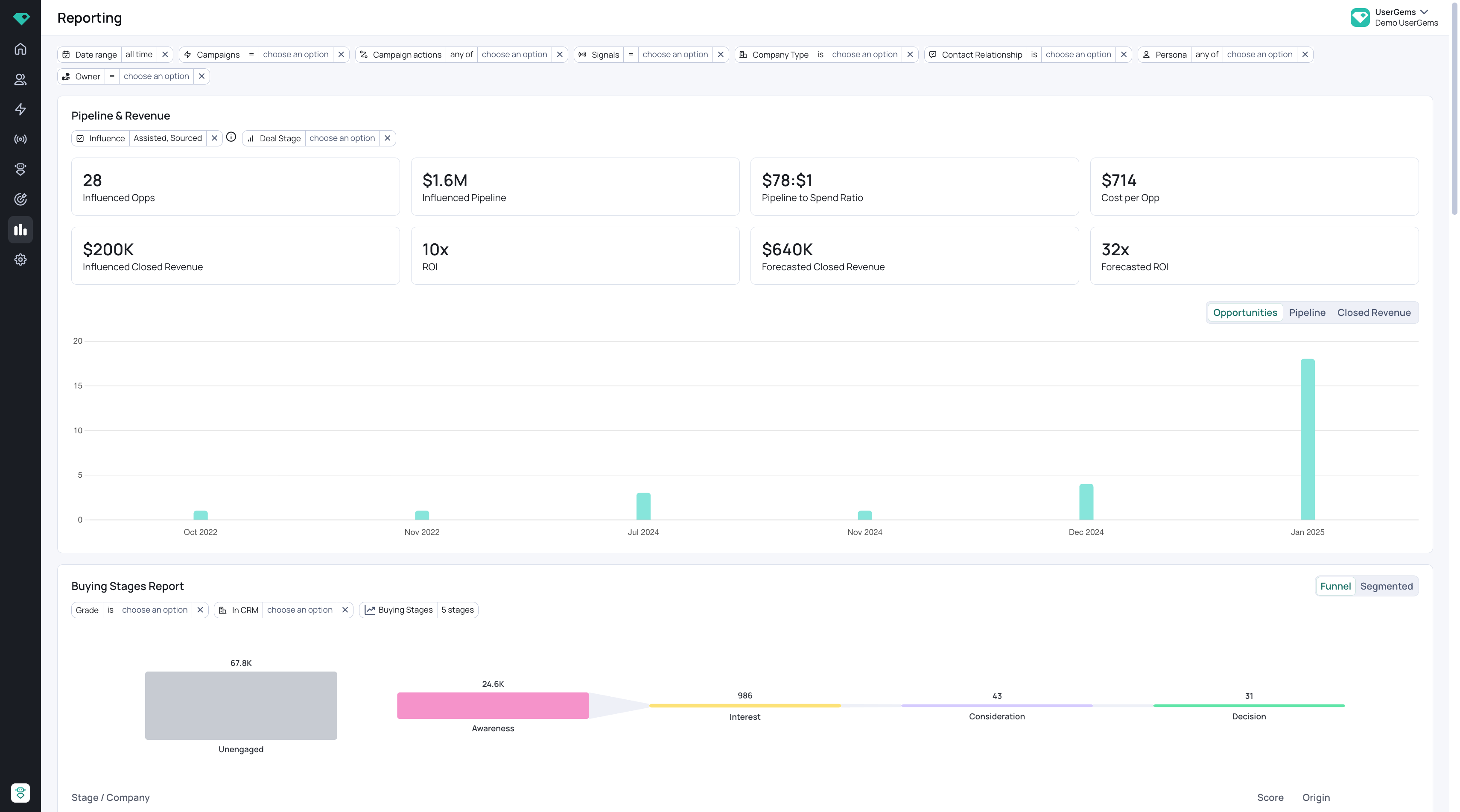
Reporting is the deep-dive analytics view. Filters across the top cut everything by date range, campaign, campaign actions, signals, company type, contact relationship, persona, and owner.
- Pipeline & Revenue shows the same KPI tiles as Home (Influenced Opps, Influenced Pipeline, Pipeline to Spend Ratio, Cost per Opp, Influenced Closed Revenue, ROI, and forecasts) with a time-series chart you can flip between Opportunities, Pipeline, and Closed Revenue.
- Buying Stages Report visualizes your whole universe moving through stages: Unengaged, Awareness, Interest, Consideration, and Decision, as a funnel or segmented view, with a stage-by-company breakdown beneath it.
- Buying Stages Trends charts how accounts move between Awareness, Interest, Consideration, and Decision over time, with range and timeframe controls.
- Records Sent x Engaged measures follow-through, for prospects or companies: People Sent, People Engaged, People Not Engaged, and Median Touches per Person, with an engagement donut, a Touches per Person breakdown (1-2, 3-4, and 5+ touches), and a monthly chart overlaying engaged and not-engaged volume with median touches per person. This is where you check the 5+ activities benchmark.
- Team Performance breaks the same engagement and pipeline metrics down by team member: Contacts Sent, Contacts Engaged, Median Activities, Opps, and Pipeline.
- Signal Influence shows which signals are earning their keep: contacts sent, engagement rate, median activities, opps, and pipeline per signal.
- Sequences Performance covers your sequences: steps, prospects, reply rates, prospects finished, finished-replied rate, and average steps completed, with search and the option to pin UserGems sequences.
Settings
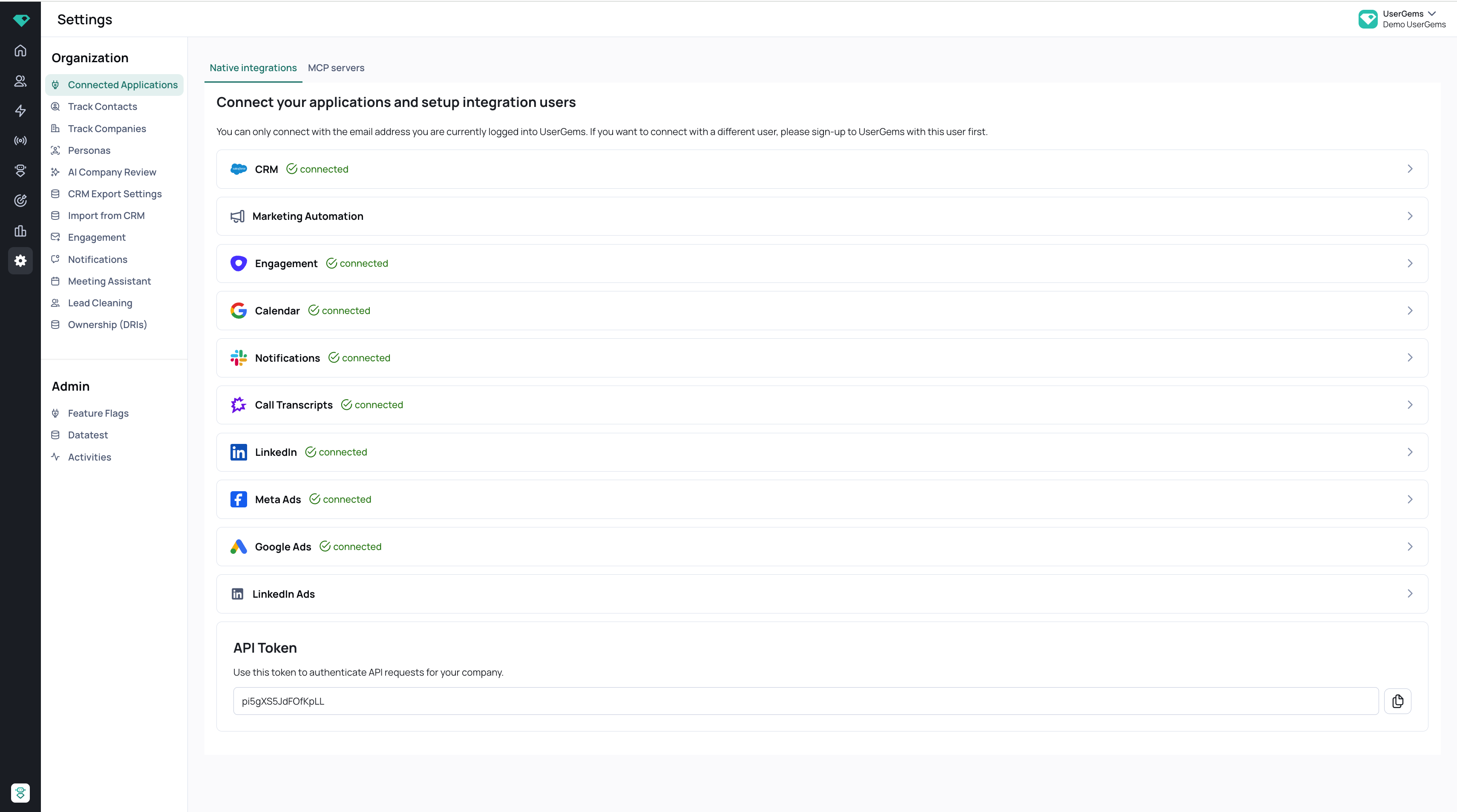
Settings is home base for configuration. The Organization menu covers everything an admin manages:
- Connected Applications is where your integrations live: CRM, Marketing Automation, Engagement (your SEP), Calendar, Notifications (Slack), Call Transcripts, LinkedIn, and your ad platforms (Meta Ads, Google Ads, LinkedIn Ads), each with its connection status. One rule to know: you can only connect with the email address you're currently logged into UserGems with. Your company API Token lives at the bottom of this page, and an MCP servers tab sits alongside the native integrations.
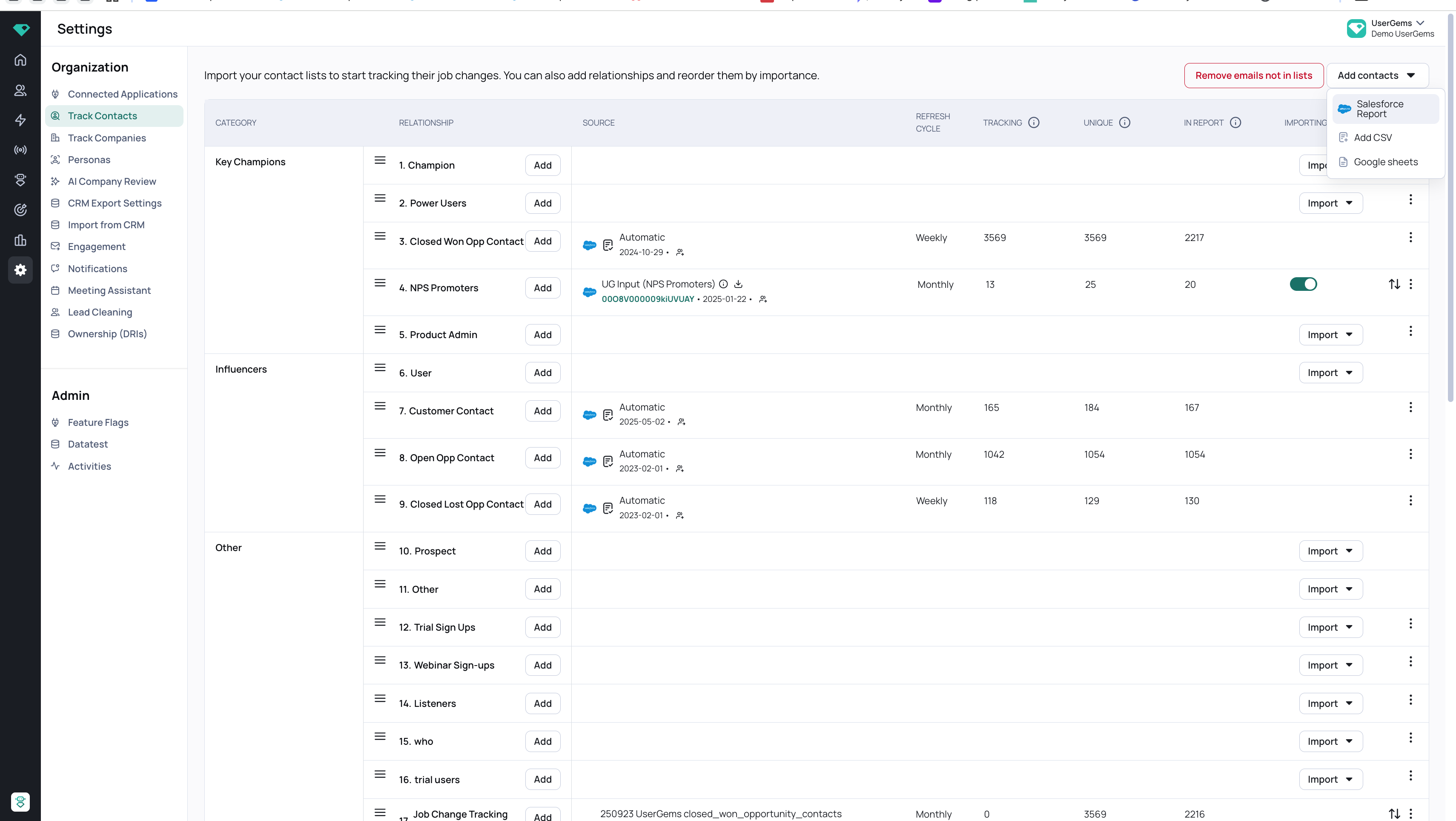
- Track Contacts manages the contact lists UserGems watches for job changes, organized into categories (like Key Champions, Influencers, and Other) with relationships you can reorder by importance. Each relationship shows its source (Salesforce report, CSV, or Google Sheets), refresh cycle (weekly or monthly), and its Tracking, Unique, and In Report counts.
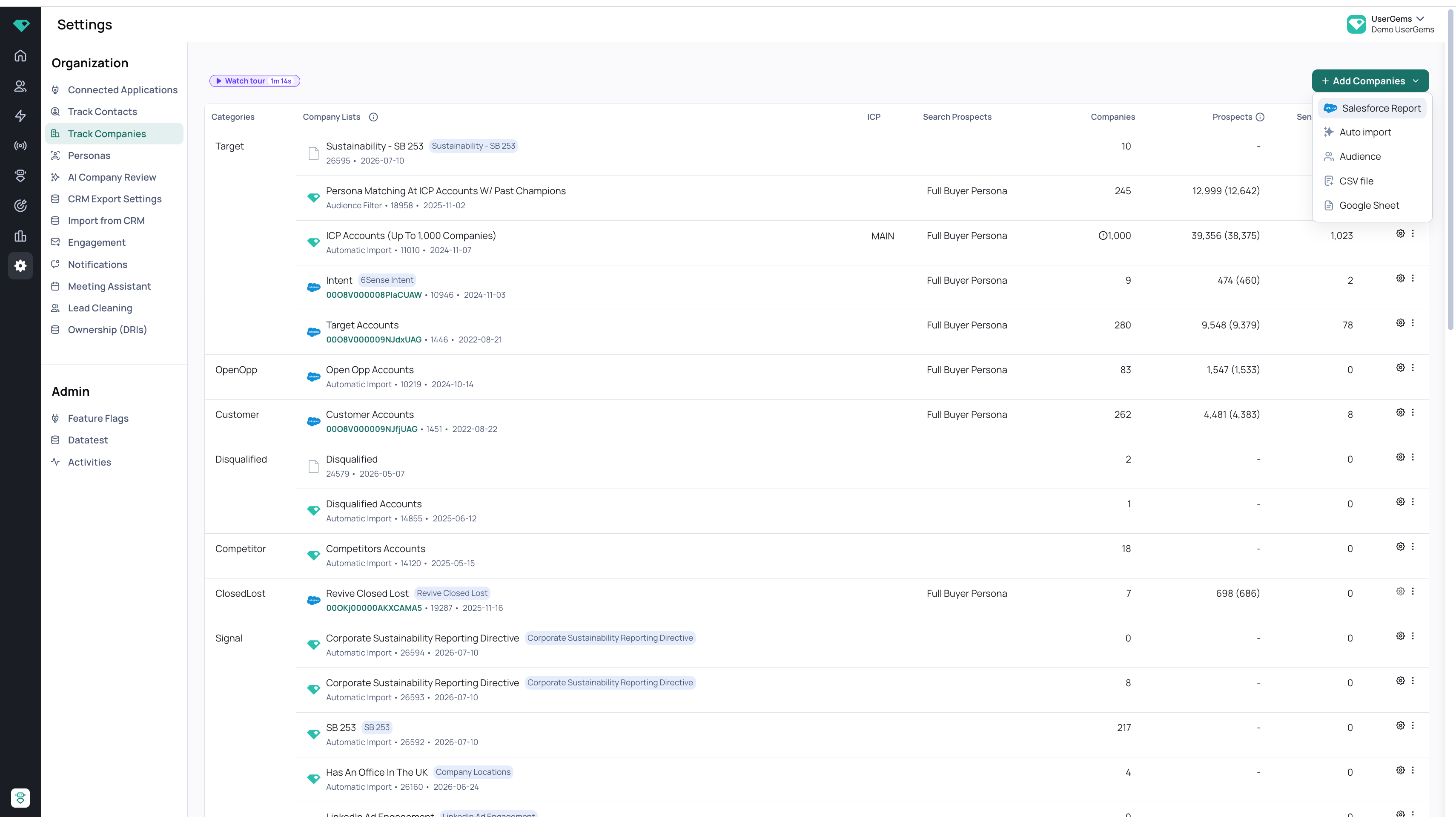
- Track Companies manages your account lists by category: Target, OpenOpp, Customer, Disqualified, Competitor, ClosedLost, and Signal. Each list shows its source, its ICP assignment, whether Search Prospects is on and with which persona, and its company and prospect counts. Add Companies supports Salesforce reports, auto import, Audiences, CSV files, and Google Sheets. Click into any list to control how many companies to import, toggle Search Prospects, and pick the persona it searches with.
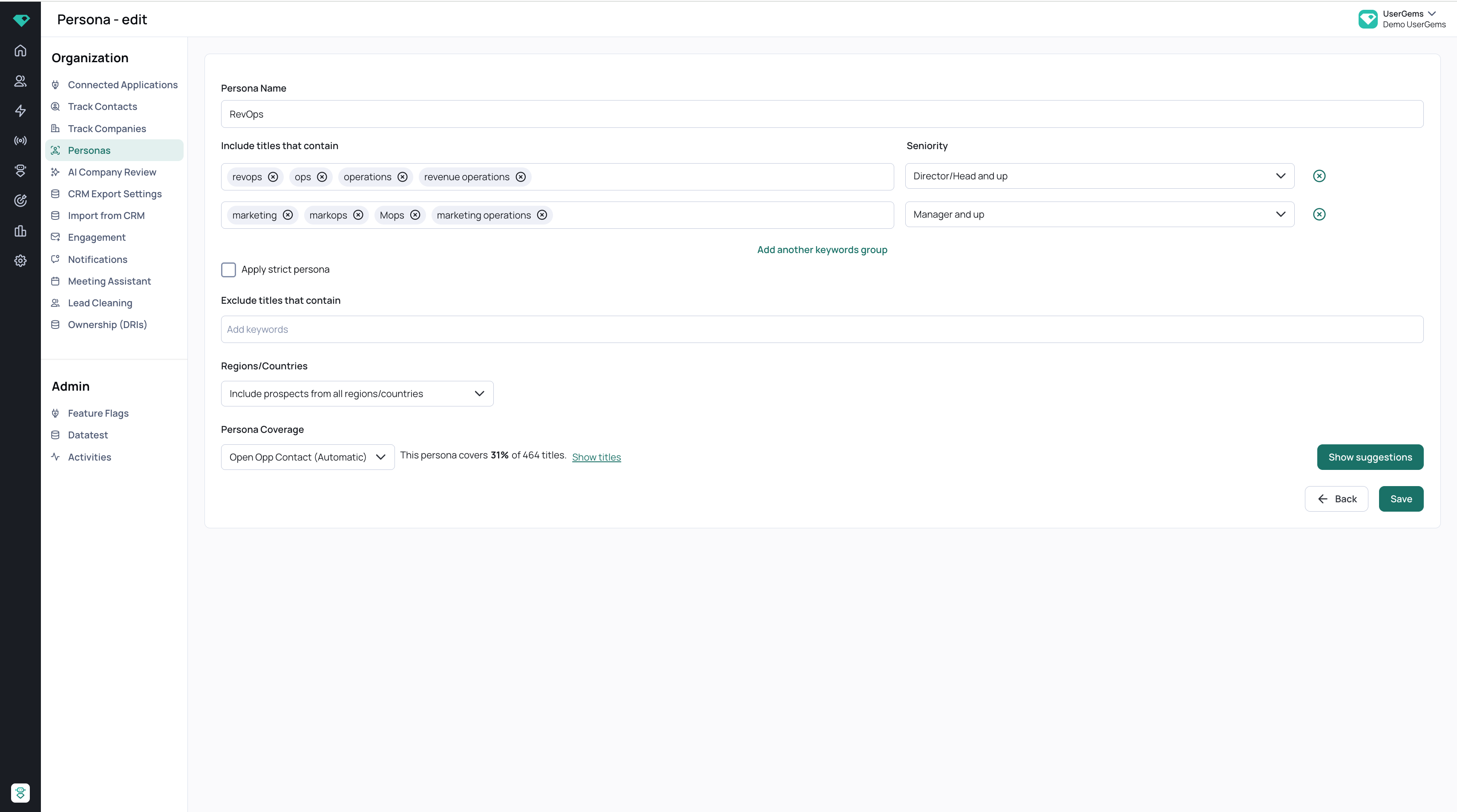
- Personas lists your personas with their coverage percentage, a Use for Persona Matching toggle, and an Importance level. Editing a persona is where the real work happens: keyword groups of titles to include, each with its own seniority floor (like Director/Head and up), exclusion keywords, the Apply strict persona checkbox, regions and countries, and a live coverage readout with Show titles and Show suggestions.
- AI Company Review trains your scoring model by rating companies.
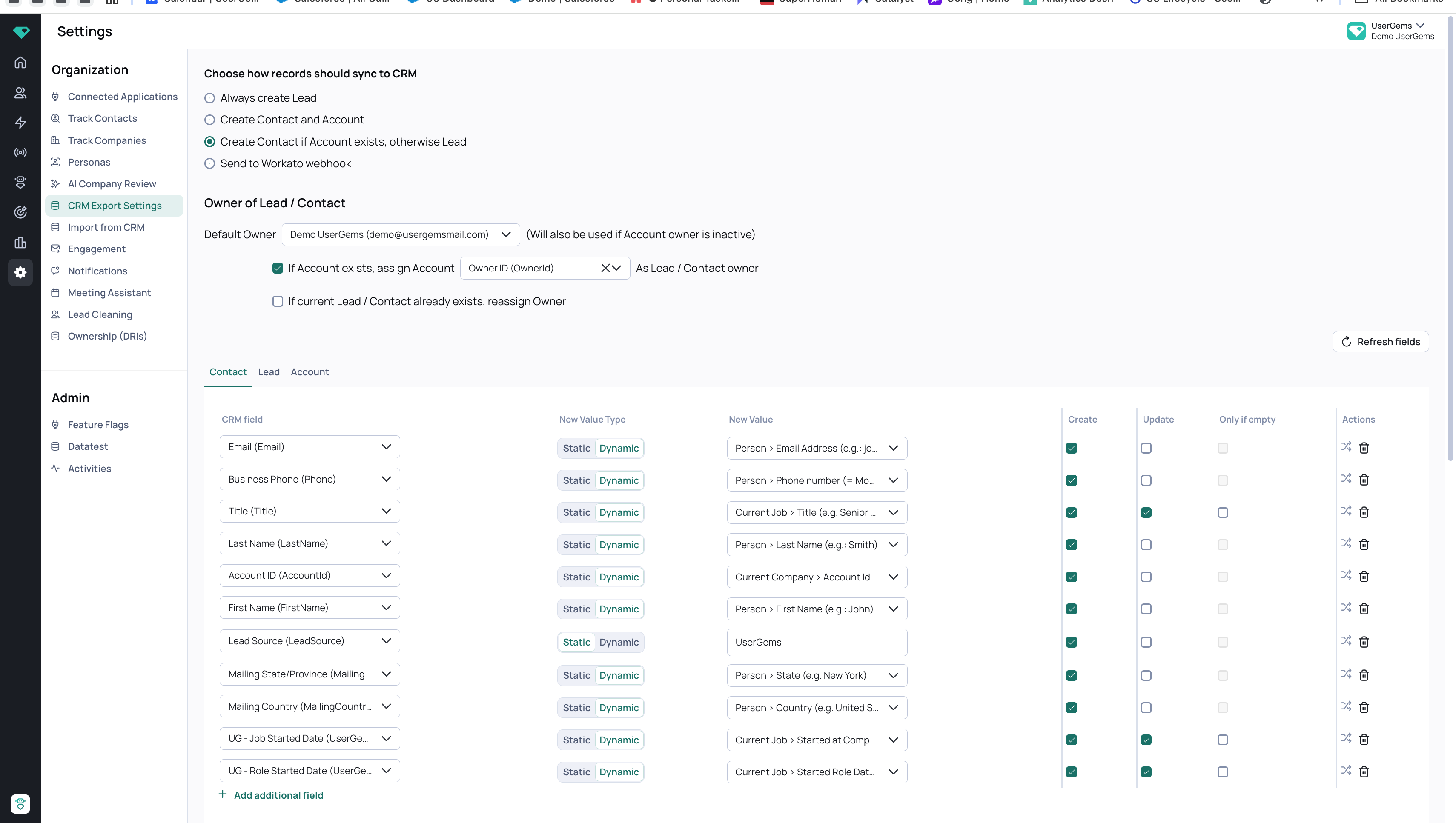
- CRM Export Settings controls how UserGems writes to your CRM: the record creation plan (Always create Lead; Create Contact and Account; Create Contact if Account exists, otherwise Lead; or send to a webhook), default and account-based ownership, and the full field mapping table for Contacts, Leads, and Accounts, where each field has a static or dynamic value and Create, Update, and Only if empty controls. Past Champion Settings and scheduled Account updates live here too.
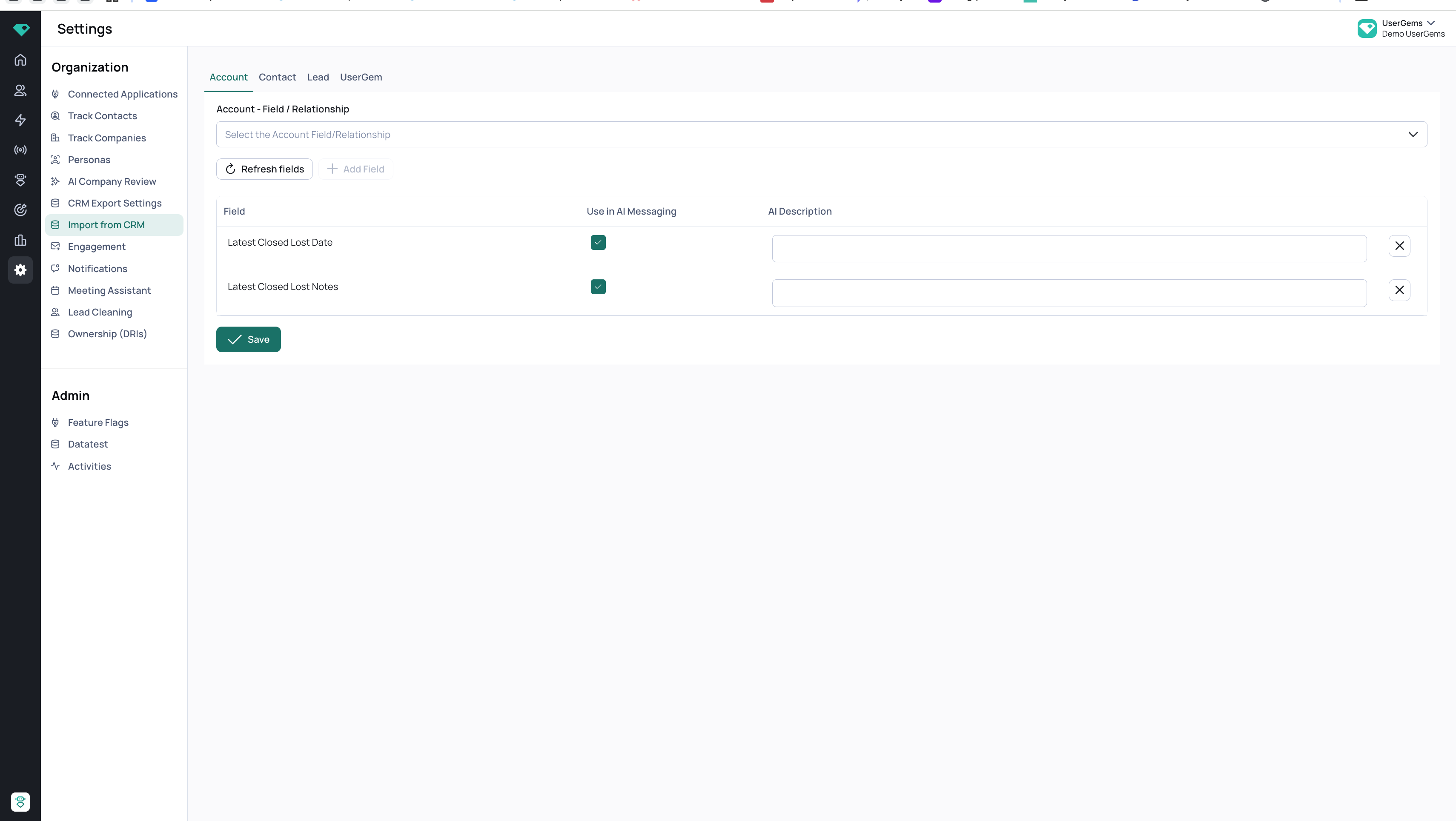
- Import from CRM brings CRM fields into UserGems from the Account, Contact, Lead, and UserGem objects. Each imported field has a Use in AI Messaging toggle and an optional AI Description, so your CRM data can feed Gem-E's personalization as well as your audience filters.
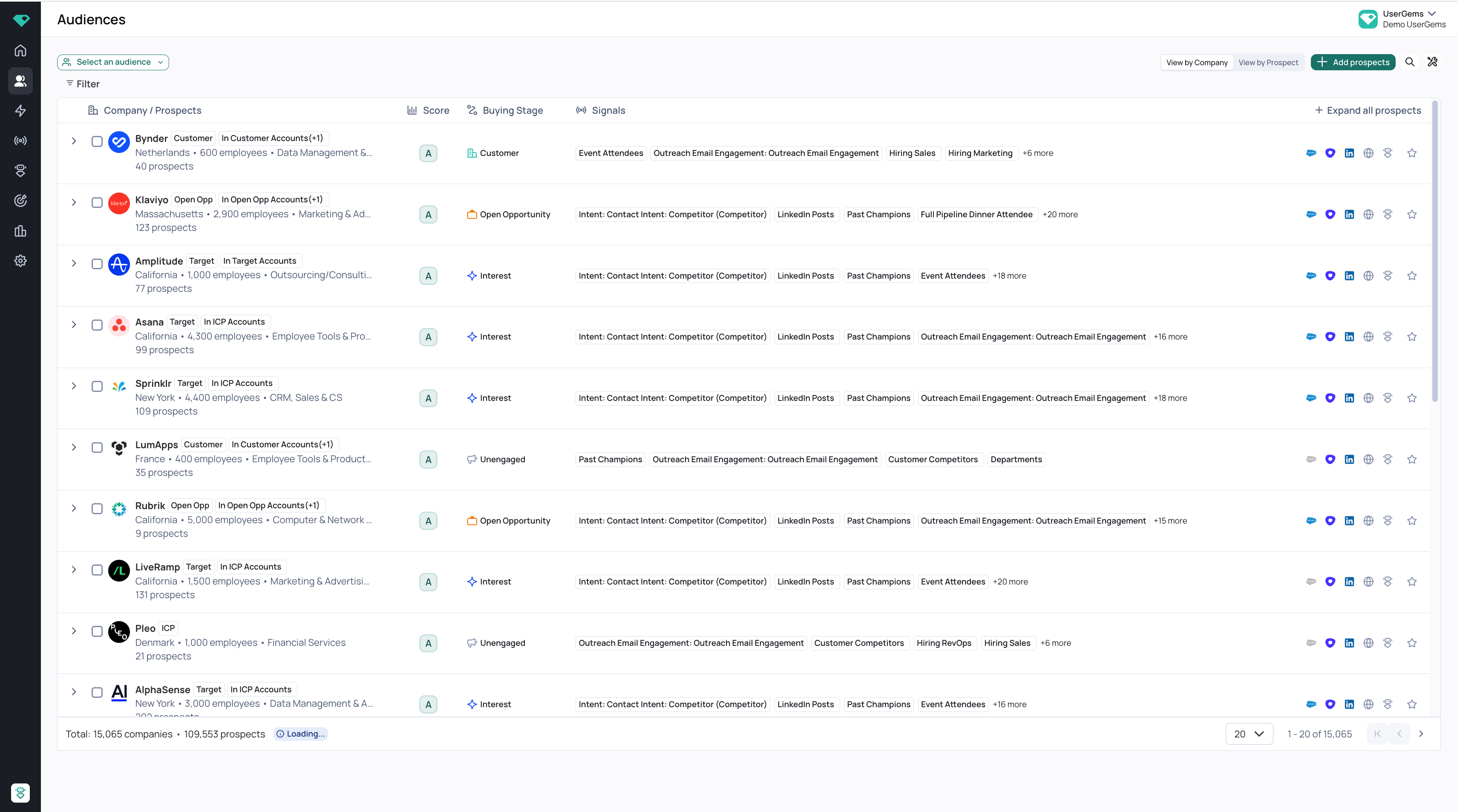
- Engagement wires UserGems to your SEP: data mappings, the Writing Agent subjects and bodies mapping (Subject 1 through 7 and Body 1 through 7 to your SEP's custom fields), and syncing UserGems template sequences to your SEP.