


Overview
This article covers:
- What tracked accounts are and how they are used in UserGems.
- How to upload and manage tracked accounts.
- How to address the following notifications:
- No Target Accounts Uploaded
- No Open Opp Accounts Uploaded
- No Customer Accounts Uploaded
What Are Tracked Companies?
Tracked companies are lists or reports of key accounts uploaded into UserGems. Uploading your tracked accounts serves two main purposes:
- It tells UserGems which accounts are important to you and (optionally) which accounts to find relevant prospects for.
- It ensures the right actions and messaging are triggered based on the account category a person is at.
For example, messaging for someone who joins a target account should be very different from messaging for someone who joins a customer account. Proper categorization when uploading tracked accounts helps keep these swim lanes clear.
Tracked Companies Page Overview
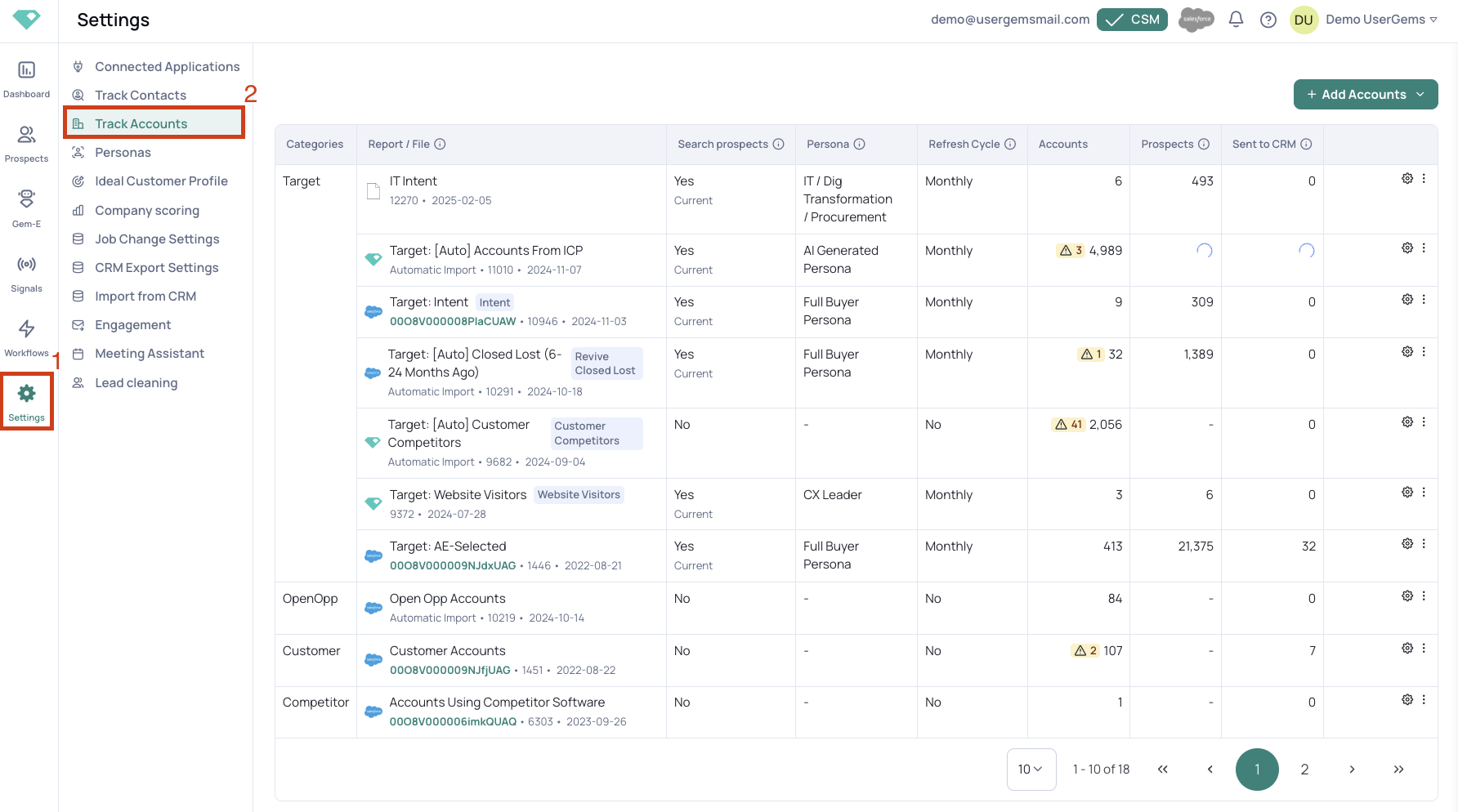
Categories: Group accounts by category to trigger the right actions.
- Target Accounts: Accounts you want to actively prospect into.
- Open Opportunity Accounts: Accounts actively evaluating where the action might be deal acceleration.
- Customer Accounts: Active customers where the focus is preventing churn, strengthening relationships, and driving expansion.
- Disqualified Accounts: Accounts you want to avoid (e.g., competitors, partners, etc.).
- Accounts w/ Signals: Accounts with specific signals (e.g., accounts with past champions). This section updates automatically as signals are activated.
- Other: Miscellaneous account types where you’d like to drive specific actions.
Report/File: Lists the reports/files uploaded in each category to monitor for signals. If it’s a CRM report, a hyperlink to the report will be included along with the upload date.
Search Prospects:
- Yes → UserGems searches for net new prospects at these accounts matching the associated persona definition.
- No → Not all accounts require new prospect searches. For example, Disqualified Accounts wouldn’t need prospecting, but workflows should ensure no action is taken if someone lands at one of these accounts.
Persona: Displays the persona used to identify relevant prospects at these accounts. For more details, see the Ideal Personas article.
Refresh Cycle: Determines how often UserGems scans tracked accounts for new prospects. While refreshes can be monthly or quarterly, the first scan happens immediately upon adding an account to a tracking list.
Accounts: The number of unique contacts being monitored, consuming a tracked credit after deduplication across relationships.
Prospects: The number of net new contacts UserGems found matching your persona at these accounts.
Sent to CRM: The number of contacts UserGems has sent to your CRM from this report.
Settings: Manage settings via the gear icon, including:
- Report name & category
- Search for prospects
- Persona to search for
- Refresh frequency
Creating a Tracked Companies List
The way companies denote key accounts varies. Below is a recommended starting point:
Essential Tracked Accounts: Every UserGems customer should always upload:
- Target Accounts
- Customer Accounts
- Open Opp Accounts
If you see an alert indicating a missing group, upload it promptly to ensure smooth workflows. This prevents prospect messaging from reaching customers or open opp accounts where different engagement strategies apply (e.g., expansion or acceleration).
Target Accounts Report (Example from UserGems):
- Columns: Company Name, Company Website, Company ID (Required fields)
- Filters: Report type = Accounts, Type = Prospect, ABX = Not Empty (specific field for target accounts)
Customer Accounts Report:
- Columns: Company Name, Company Website, Company ID (Required fields)
- Filters: Report type = Accounts, Type = Customer (excludes churned customers)
Open Opp Accounts Report:
- Columns: Company Name, Company Website, Company ID (Required fields)
- Filters: Report type = Opportunities, Show me = All Opportunities, Close Date = All Time, Opportunity Status = Open, Type = New Business (excludes renewal opportunities), Stages = Everything after Stage 1 (ensuring a meeting took place).
Uploading Tracked Companies
To upload new accounts for persona tracking:
- Create your tracked accounts list.
- Required columns: Company Name, Company Website, Company ID
- IMPORTANT: Tracking more accounts may consume additional UserGems credits—review your credit usage before uploading.
- Click "+ Add Accounts" in the top right of the page.
- Select an upload method:
- CRM Report (Best Option) → Enables dynamic scanning as new accounts meet the criteria.
- Save the report in a public folder.
- Copy and paste the 18-digit (SFDC) or 3-4 digit (HubSpot) ID from the report URL into UserGems.
- Share the sheet as “Viewer” with tracking-google-spreadsheets@usergems-calendar-tracking.iam.gserviceaccount.com
- Copy and paste the GID (~10 digits) from the sheet URL (look for GID=).
- Google Sheet (Second Best Option) → Easier for adding accounts later but requires manual adjustments unless using Zapier or similar integrations.
- CSV (Least Recommended Option) → Static uploads require frequent updates to capture new accounts.
- Name the import, select a category (e.g., Target, Customer, Open Opp), and map the columns.
- CRM Report (Best Option) → Enables dynamic scanning as new accounts meet the criteria.
- Map columns
- Set up prospect search by selecting the persona and refresh cycle (how often UserGems scans for persona titles).
- Click "Finish"


Segmenting Your Tracked Companies
In many cases one report for each category does the trick with one major exception:
You want unique scoring and prioritization models per vertical or tier. Here's the chain: each scoring model is tied to an ICP definition, and each ICP definition is modeled on a Track Companies report. So separating your customer reports by vertical or tier gives the AI a cleaner starting point for each ICP.
Example: funding news is a strong signal in Vertical A but irrelevant in Vertical B. With separate uploads, you get two distinct ICPs and can weight funding heavily in Vertical A's scoring while ignoring it in Vertical B's.
What if I don't have companies to track?
Check out this article on Automatically Importing companies based on which companies are ranked highest using our AI Company Scoring.